
Is SEO Dead?
Every few years, someone declares SEO dead. Social media was supposed to kill it. Then voice search. Then TikTok. Now it’s AI.
And this time, the panic isn’t baseless. ChatGPT, AI Overviews, Perplexity people are searching differently. Fewer clicks are landing on websites. Marketers are watching their traffic graphs dip and wondering if the game they’ve spent years learning just ended.
So let’s actually answer it is SEO dead?
No. But it’s not the same job it was two years ago either.
What’s actually happening
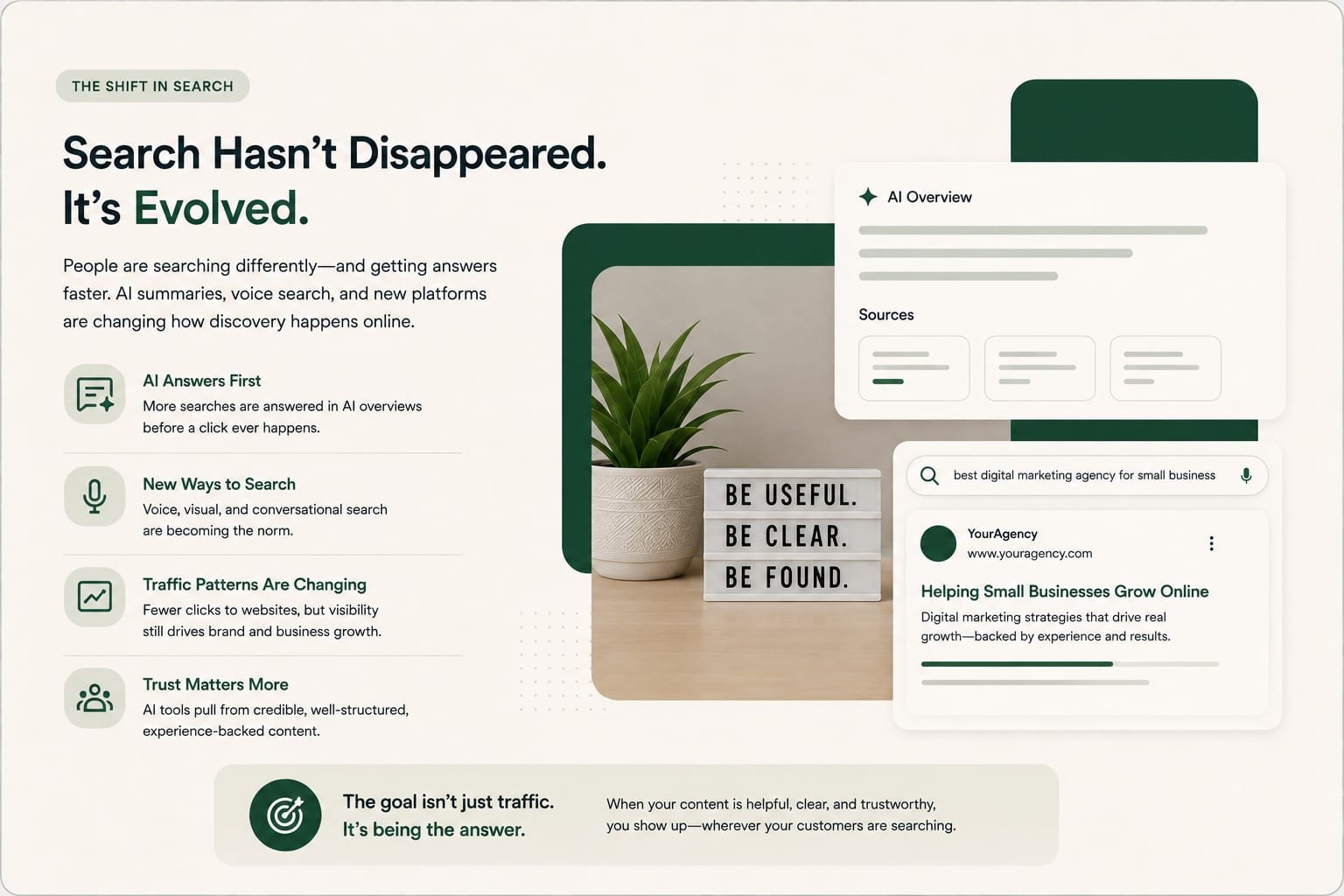
Search hasn’t disappeared it’s moved. A large chunk of queries now get answered directly inside an AI summary, before a person ever clicks a blue link. That’s a real shift, and it’s shrinking traffic for a lot of websites.
But here’s the part that gets lost in the panic AI tools don’t invent their answers out of thin air. They’re pulling from somewhere. Someone’s content is still getting read, summarized, and cited. The businesses that show up in those answers are usually the ones that already had clear, credible, well-structured content the kind that was always good SEO, AI or not.
So the traffic pattern is changing. The need to be findable and trustworthy online hasn’t.
What this means if you run a small business
You don’t need to abandon SEO. You need to stop treating it like a checklist of keywords and start treating it like a reputation exercise.
A few things that matter more now than they did before
– Write like someone who’s actually done the thing, not like someone who read ten articles about the thing. Real experience is what AI systems (and humans) trust.
– Answer the actual question clearly, early, and in plain language instead of burying it under 800 words of introduction.
– Keep your basics tight your Google Business Profile, your site speed, your structure. Boring, unglamorous, still important.
– Think beyond Google. Being useful enough to get mentioned, quoted, or linked to on Reddit, review sites, industry blogs is quietly becoming part of “SEO” too.
The honest takeaway
SEO isn’t dying. The lazy version of it is. The version built on stuffing keywords and chasing algorithms instead of actually helping the person on the other end.
If your content has always been genuinely useful, you have less to fear from this shift than the headlines suggest. If it hasn’t, now’s a fair time to fix that not because AI is coming for you, but because it never stopped being the right way to do this.